
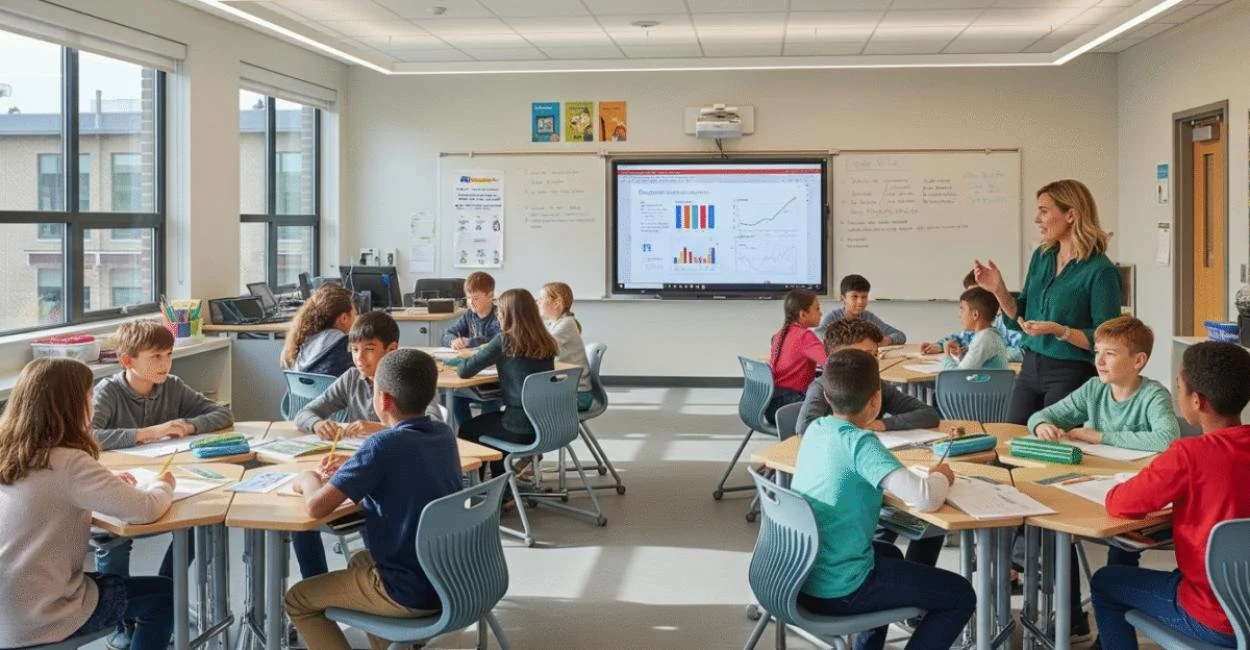
One room, every level, one shared idea
Differentiation built into every lesson, not bolted on after.
Most curriculum asks you to differentiate on your own time. MicroCore writes it in. Every lesson is designed so a student working two years below grade level can enter the thinking, and a student working two years above can extend it, on the same task, in the same room.
The Three Stages
In reading and writing, the work comes in three Stages. Stages describe the complexity of the work, never a label a student wears, and placement stays fluid.
Stage 1
Enters the Thinking
For students working below grade level, anchored to a Grade 1 to 2 band. This is authentic grade-band work, not a watered-down version. Students can demonstrate understanding through drawing, speaking, or short writing.
Stage 2
The Shared Center
Whole-group instruction lands here most often. Pitched to beginning Grade 4, it stretches on-grade learners while remaining accessible with support for Stage 1 students.
Stage 3
Extends with Depth
Students synthesize ideas, defend arguments, and extend into early Grade 6 expectations whenever they are ready.
Whole-group instruction lands at the upper end of Stage 2. Stage 1 learners reach upward with support, while Stage 3 learners extend the lesson with greater depth. Students may work at different Stages in literacy and different Levels in math.

Math, leveled to where each student works
Math runs on its own track, and every student works at the level that fits them.
The Math Practice Workbook comes in three different levels, with support that reaches below and above them. A student is placed by a short diagnostic and the teacher’s observation, not by their grade. A daily opener still brings the whole room together to reason through one shared problem, and Responsive Math groups let the teacher pull the exact skill a student needs.
The test every lesson passes
Before a lesson ships, it has to pass one test, in three lenses.
🚪
Floor
Can the lowest student enter the
thinking?
📈
Ceiling
Can the highest student extend it with nuance and argument?
🎯
Shared task
Is it genuinely the same task, so the whole room works on one idea together?
Thinking is not gated by reading
A student who cannot yet read the passage can still enter the idea.
Every anchor task moves along a cognitive ladder: see it, the concrete; name it, the pattern; explain it, the abstraction. The middle rung is never skipped, because that is the rung that makes the pattern visible for the students who need it. And students show their thinking in the mode that fits: speaking, building, or writing, treated as equal paths to the same target.

See the whole program for yourself.
Open a free week inside the workspace, or see what a license includes.